
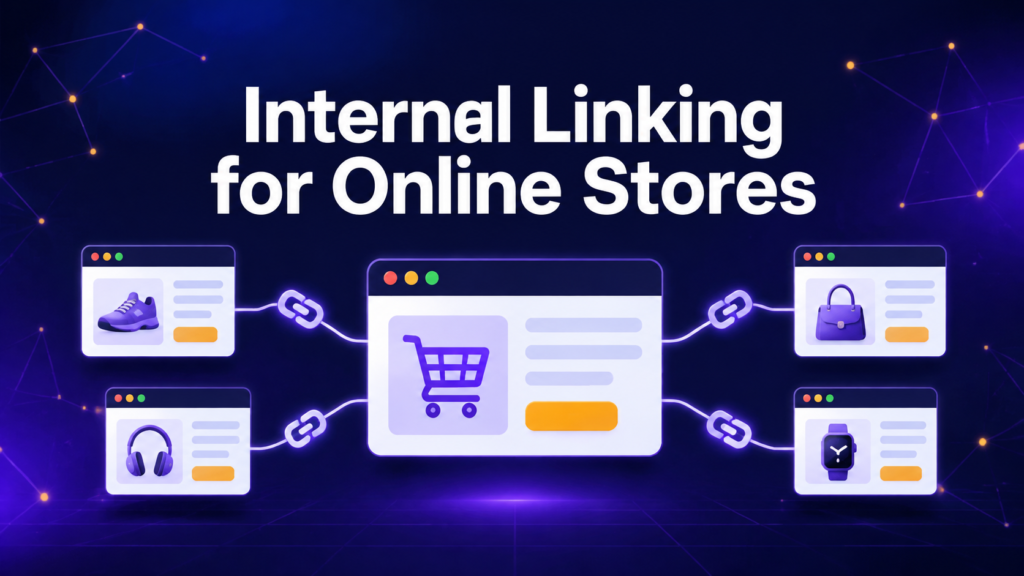
Your online store might have excellent products, detailed descriptions, and competitive prices, yet some product pages still struggle to appear in search results. One possible reason is that those pages aren’t receiving enough attention from the rest of your website.
Internal linking helps search engines discover your products, understand how pages relate to one another, and identify which pages matter most within your store. It also gives shoppers useful paths between categories, product details, buying guides, and related items.
For ecommerce brands, the goal isn’t simply to add more links. It’s to create a website structure that directs visitors and search engines toward the products you want them to find.
What Internal Linking Means for Ecommerce SEO
An internal link connects one page on your website to another page on the same domain. Examples include a category page linking to products, a blog post linking to a featured item, or a product page linking to complementary accessories.
These links serve several purposes:
- Help search engines discover product pages.
- Explain relationships between categories and products.
- Provide context about the destination page.
- Distribute link equity throughout your website.
- Give shoppers easier access to relevant products.
Link equity, often called link authority or link value, refers to the value associated with links that can contribute to a destination page’s search performance.
Google considers links when discovering pages and understanding their relevance. Its ecommerce documentation also explains that the number of links pointing to a page can help indicate its relative importance within a website.
This doesn’t mean adding links automatically improves rankings. Internal linking works alongside content quality, technical SEO, relevance, and other factors.
Build a Clear Path From Your Homepage to Product Pages
A well-organized ecommerce website should make important products accessible through logical navigation.
A common structure looks like this:
- Homepage
- Category Pages
- Subcategory Pages
- Product Pages
For example, a home furnishings store might organize its website as:
- Homepage -> Bedroom Furniture
- Bedroom Furniture -> Bed Frames
- Bed Frames -> Individual bed frame products
This structure helps shoppers narrow their choices while giving search engines a clear route to product pages.
However, don’t rely exclusively on this hierarchy. Important products may benefit from additional links from relevant blog posts, seasonal landing pages, or other useful sections of your website.
Link From High-Value Pages to Important Products
Some pages on your website naturally attract more internal and external links than others.
Your homepage, popular category pages, and established informational articles may provide useful opportunities to direct visitors and search engines toward important products.
Consider a store selling fitness equipment. Its homepage might link to a popular resistance band collection, while a training guide could link directly to the resistance bands used in a particular exercise.
These connections help establish relationships between relevant content and commercial pages.
Identify Which Products Deserve Priority
Not every product needs the same level of attention.
Start by identifying:
- Best-selling products.
- Products with strong profit margins.
- Products receiving organic impressions but few clicks.
- Important products with limited internal links.
- New products that need better discovery.
A product with strong business value but poor internal visibility may deserve additional links from relevant pages.
Avoid adding every product to your homepage. Use category pages, relevant articles, and carefully selected promotional sections to maintain a balanced structure.
Use Descriptive Anchor Text
Anchor text is the visible text users click to follow a link.
Good anchor text explains what the destination contains. It gives shoppers a useful indication of where they’re going and provides search engines with contextual information.
For example:
Weak anchor: View product
Better anchor: Adjustable standing desk
The second option describes the destination more clearly.
Keep Anchors Natural and Relevant
Don’t force exact-match keywords into every internal link.
If you’re linking to a product called a lightweight waterproof hiking backpack, you could use anchors such as:
- Lightweight hiking backpack
- Waterproof backpack for hiking
- Explore this hiking backpack
Choose wording that fits the surrounding sentence.
Avoid repeating the same keyword-heavy anchor across every page. Internal links should read naturally and help users navigate, not make product descriptions awkward.
Connect Blog Content to Relevant Product Pages
Informational content can support ecommerce pages by connecting shoppers who are researching a purchase with products that meet their needs.
A blog post about choosing running shoes, for example, could link to suitable running shoe categories or specific products mentioned in the article.
This approach works particularly well when shoppers need information before making a purchase.
Useful content-to-product connections include:
- Buying guides linking to recommended products.
- Tutorials linking to equipment used in the instructions.
- Comparison articles linking to the products being compared.
- Seasonal guides linking to relevant collections.
- Care instructions linking to replacement parts or accessories.
The connection should make sense for the reader. A product link inserted into an unrelated article is unlikely to provide much value.
For stores investing in content marketing, our SEO services can help connect content strategy with ecommerce search visibility.
Add Related Products and Complementary Links
Product pages can also strengthen internal linking by directing shoppers to relevant items.
Consider a store selling cameras. A camera product page might link to compatible lenses, memory cards, camera bags, and related models.
These links help shoppers discover useful alternatives or accessories while reinforcing relationships between products.
There are several ways to organize these links:
Related products: Items similar to the current product.
Frequently bought together: Products that complement the main item.
Compatible accessories: Products designed to work with the selected item.
Alternative options: Products with different features, sizes, or price points.
Keep recommendations relevant. Showing unrelated products simply to create additional links can confuse customers and weaken the usefulness of your product pages.
Optimize Breadcrumbs and Category Navigation
Breadcrumbs provide a trail showing where a product sits within your website.
For example:
Home -> Outdoor Gear -> Hiking Backpacks -> Product Name
They help shoppers return to broader categories without starting over. Breadcrumbs also provide search engines with additional information about the relationships between pages.
Use consistent breadcrumb navigation across your store.
Make sure each breadcrumb points to a meaningful destination and uses crawlable links rather than relying entirely on JavaScript interactions.
Category navigation deserves similar attention. Important categories should be accessible through menus, and product listings should provide links to individual product pages.
If your store has hundreds of categories, review whether the navigation reflects how customers actually browse.
Avoid Common Internal Linking Mistakes
Even a large number of internal links won’t help much if the underlying structure is confusing.
Watch for these problems:
Orphaned product pages: Products with no internal links pointing to them are harder for search engines and shoppers to discover.
Broken links: Links leading to deleted products or unavailable pages create frustrating navigation experiences.
Excessive irrelevant links: Adding unrelated product links throughout your website makes navigation less useful.
Duplicate product URLs: Ecommerce platforms may generate different URLs for the same product depending on the collection or navigation path. Link consistently to the preferred canonical URL.
Overreliance on filters: Filtered category pages can generate many URLs. Don’t assume every filtered variation deserves internal links or search indexing.
JavaScript-only navigation: Use standard HTML links with valid destinations so crawlers can reliably discover your pages.
If you suspect competing pages are targeting the same search terms, review them with the free keyword cannibalization checker.
Measure and Improve Your Internal Linking Strategy
Internal linking should be reviewed regularly, particularly for stores with changing inventories.
Start with a practical audit:
- Identify important product pages and categories.
- Check whether each product has at least one relevant internal link.
- Review links from the homepage, navigation, and category pages.
- Find broken links and outdated product references.
- Check whether important pages are buried too deeply.
- Review organic performance before and after meaningful changes.
Google Search Console can help you monitor product page impressions, clicks, and indexing issues. A crawling tool can help identify orphaned pages, broken internal links, and pages receiving few internal links.
Don’t judge success by link counts alone. Look at whether search engines can discover important products, whether organic visibility improves, and whether shoppers can navigate your store more easily.
Give Your Product Pages the Visibility They Deserve
Internal linking is an ongoing part of ecommerce SEO, not a one-time website adjustment.
A clear site structure, useful category navigation, descriptive anchor text, and relevant connections between content and products can help search engines understand your store while making shopping easier for customers.
Start with your most important products, identify where they need better connections, and make improvements that serve both search engines and shoppers.
If your store has complex navigation, thousands of products, or product pages that struggle to gain organic visibility, Nova X Ventures can help you review your website structure and identify practical opportunities. Feel free to contact Nova X Ventures when you’d like to discuss your ecommerce SEO priorities.